



Key Takeaways
- Calculate capacity from the fully loaded equipment weight, not the empty unit.
- Allow reserve capacity for uneven loads, bumps, ramps, and changing floor conditions.
- Match wheel tread material to the floor, operating environment, and noise requirements.
- Use larger wheels when routes include thresholds, cracks, grates, or uneven surfaces.
- Select swivel, rigid, locking, leveling, or spring-loaded casters according to how the equipment moves and stops.
- Inspect wheels, bearings, brakes, and mounting hardware regularly.
The right caster wheels can make a loaded cart, rack, trolley, or piece of equipment easier to control, quieter to move, and less likely to damage the floor. Whether you are replacing worn hardware or specifying a new build, heavy duty plate casters should be selected around the complete application, not just the weight printed on a shipping label.
Load, floor condition, travel distance, turning requirements, noise limits, contaminants, and braking needs all affect the result. A wheel that works well on smooth warehouse concrete may be a poor choice for a washdown room, a finished lobby floor, or a cart that must cross thresholds several times a day.
Why Caster Selection Matters
Casters influence starting force, steering effort, stability, noise, floor wear, and the service life of the equipment they support. For example, a warehouse cart with undersized wheels may move acceptably when empty but becomes difficult to start, steer, and stop once loaded. Guidance on push-pull strain and caster selection also highlights why load capacity, wheel diameter, bearings, and shock loading deserve attention.
A small wheel issue can quickly become an operational problem. Flat-spotted treads, seized bearings, loose mounts, or inadequate brakes can increase effort for operators and make a cart less predictable during daily use.
How to Calculate Required Load Capacity
Start with the maximum total operating weight. Add the equipment’s empty weight, the heaviest expected payload, and any permanently attached accessories. Divide that figure by the number of casters, then add a reasonable margin for real conditions.
A Simple Capacity Example
Consider a cart with a maximum loaded weight of 900 pounds and four casters. Dividing 900 by four produces 225 pounds per caster. That calculation is only a starting point, because a cart on an uneven floor may not distribute weight equally across all four wheels. Choosing casters rated only to the exact 225-pound figure leaves little room for uneven loading, thresholds, ramps, or impacts.
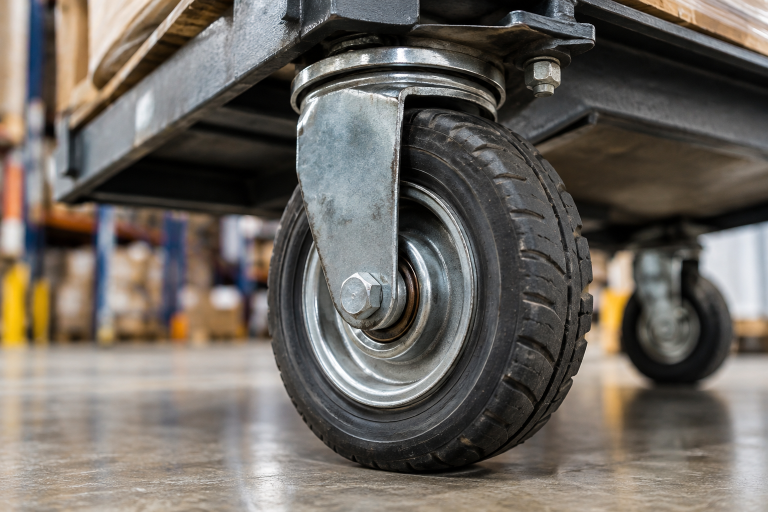
Static capacity describes support under relatively steady conditions. In use, a wheel can encounter shock loading when it strikes a ledge, dock plate, crack, or obstacle. Select a manufacturer-rated capacity that accounts for the equipment’s actual route and handling conditions.
How to Match Wheels to Floor Conditions
Review the entire travel path, including door thresholds, elevator gaps, ramps, grates, loading areas, and outdoor transitions. A caster’s wheel diameter and configuration affect how it rolls, turns, and handles changes in the surface beneath it.
- Smooth concrete: Prioritize durability, rolling efficiency, and the desired noise level.
- Tile and finished flooring: Choose a tread designed to reduce marking and surface damage.
- Cracked or uneven surfaces: Consider larger-diameter wheels and treads for added cushioning.
- Thresholds and ramps: Use wheel sizes that can clear edges with a lower risk of catching.
- Outdoor routes: Review weather exposure, tread durability, and impact resistance.
- Grates and dock plates: Confirm that wheel diameter and width are appropriate for gaps and transitions.
Larger wheels generally roll over small gaps and surface changes more easily than smaller wheels. They can also reduce the number of sharp impacts transferred into the cart and its contents.
How to Choose Wheel Material
Wheel material should fit the floor and environment rather than follow a one-material-fits-all rule. Compare the practical trade-offs before ordering.
- Rubber: Often chosen when quiet movement, cushioning, and floor protection are priorities.
- Polyurethane: Common in indoor applications needing a balance of durability, floor protection, and rolling performance.
- Nylon or polyolefin: Often considered where moisture resistance, washdown exposure, or chemical resistance is important.
- Phenolic: Used in certain higher-load or elevated-temperature applications when conditions suit the material.
- Steel or cast iron: Suitable for demanding loads and harsh settings, but can be noisy and hard on finished floors.
- Conductive or static-dissipative wheels: Appropriate only where the equipment and facility have defined static-control requirements.
How to Select Caster Style
The wheel is only part of the decision. The caster frame, swivel design, brake, and mounting method determine how equipment behaves in motion and at rest.
- Swivel casters help equipment turn in tight spaces.
- Rigid casters support straight-line tracking and directional control.
- Swivel casters with brakes suit equipment that must move and then remain stationary.
- Total-lock casters are designed to restrict both wheel rotation and swivel movement.
- Leveling casters allow mobility during setup and stable support during use.
- Spring-loaded casters can help where vibration, impacts, or uneven surfaces are recurring concerns.
Before ordering, verify plate dimensions, bolt-hole pattern, stem size, mounting clearance, and overall installed height. A properly rated caster that does not fit the mounting location is not a workable replacement.
Work Environment Factors to Review
Beyond weight and flooring, consider temperature extremes, freezers, ovens, water, chemicals, oils, debris, long routes, frequent stops, and tight turns. Hospitals, offices, hotels, libraries, and customer spaces may prioritize quiet rolling and floor appearance.
For equipment that must remain stable during loading, repairs, or operation, assess braking or leveling with the unit fully loaded. Test brakes at the actual location and in operating position.
Common Caster Selection Mistakes
- Using only the empty equipment weight.
- Selecting casters with no load-capacity reserve.
- Installing small, hard wheels on rough routes or finished floors.
- Ignoring chemicals, moisture, heat, and debris around bearings.
- Using all swivel casters when better straight-line control is needed.
- Adding brakes without confirming they can hold the loaded unit.
- Replacing one failed caster without checking wear on the others.
A Simple Inspection and Replacement Plan
Inspect casters regularly for flat spots, cracks, cuts, tread separation, uneven wear, loose fasteners, bent plates, and damaged stems. Spin each wheel to check for unusual resistance, grinding, or clicking. Remove wrapped string, film, wire, hair, and debris from axles and bearings when safe to do so.
Clean and retest components with minor debris buildup. Remove equipment from service when a wheel is cracked, a mount is loose or bent, a brake will not hold, or a caster no longer rolls or swivels reliably. Tracking repeat failures can reveal that the wheel material, capacity, or caster style does not match the application.
Final Selection Checklist
- What is the maximum loaded weight?
- How much reserve capacity is available per caster?
- Which floors, obstacles, ramps, and transitions will the equipment cross?
- Which wheel material fits the floor and environment?
- How much steering control, braking, and stability are required?
- Do mounting dimensions and installed height match the equipment?
The best caster choice considers the complete job: load, route, wheel material, movement pattern, environment, and maintenance access. That approach supports smoother operation, more dependable equipment control, and longer-lasting mobility hardware.